A customer-support agent reads tickets, updates records, and emails customers through MCP, driven by whatever a customer types. Route it through PolicyLayer and every action is checked against your policy before it runs.
For platform and security teams running AI agents in production.
It rarely looks like a breach. It looks like good service.
Connect your CRM and support desk and the agent can delete records, send emails, and update contacts, for anyone.
A customer message reads "delete my account and email everyone my note." Public, untrusted input becomes a task.
PII leaves, records vanish, and it looks like the agent simply helped.
The CRM and support-desk calls a customer-facing agent makes. PolicyLayer governs each one.
Drop PolicyLayer into your MCP request path. Your agents keep their tools. You keep control. Core concepts →
Bulk deletes and emails to external customers wait for human sign-off before they run.
Each agent's token carries only the records and actions you grant. A triage agent reads tickets; only an escalation agent edits accounts.
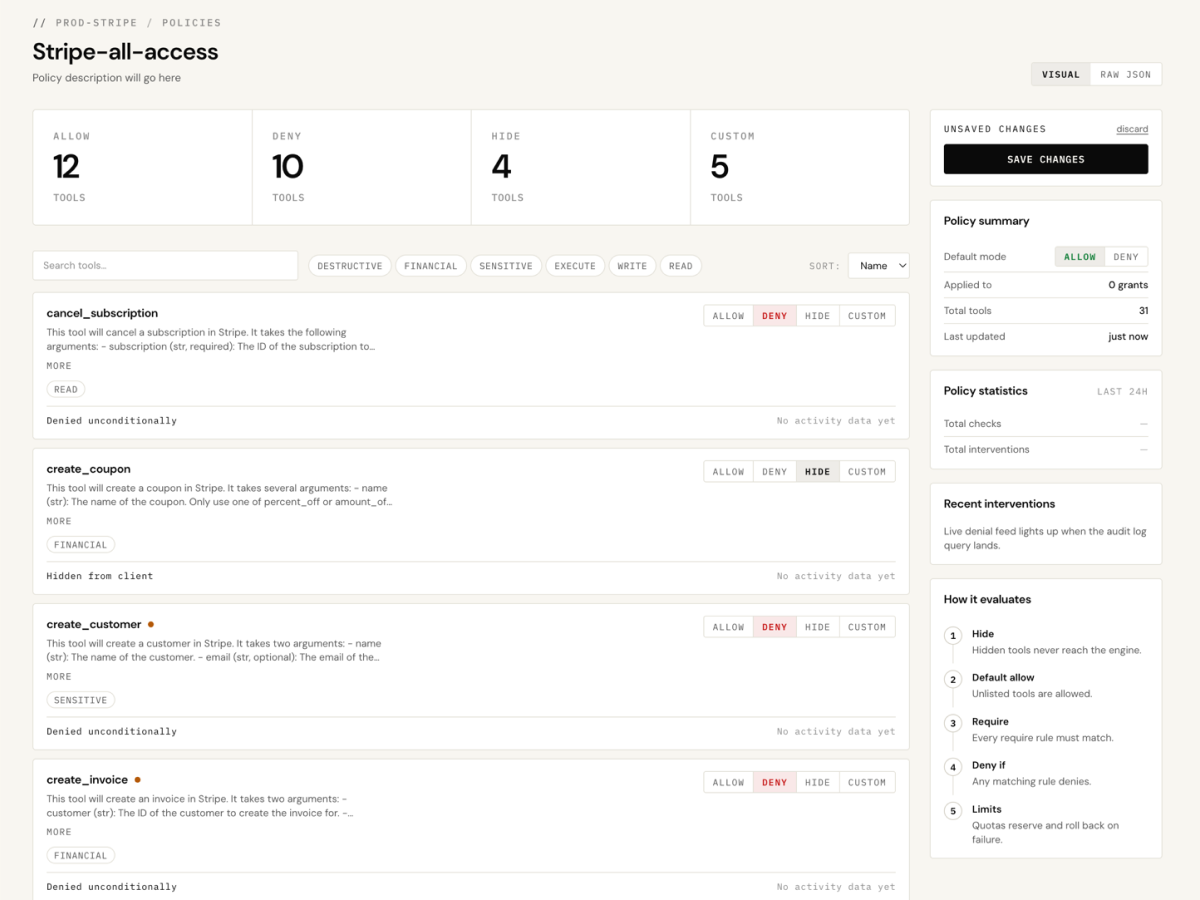
Inspect the call: deny bulk deletes, require approval to email an external address, redact PII fields from results. Writing policies →
Cap how many customers an agent can email or update an hour.
Rules run as code, first denial wins. The same call gets the same decision every time.
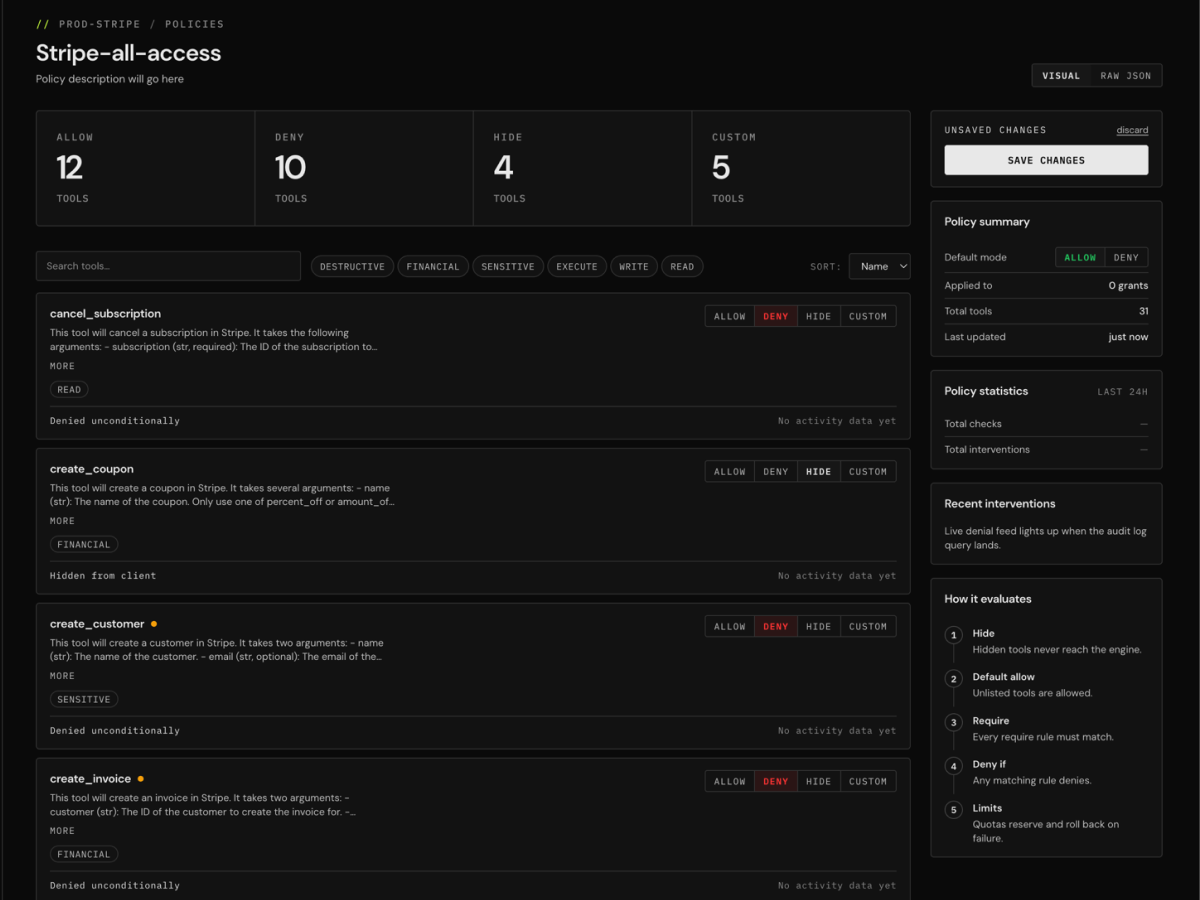
Build policy around the fields that matter (record type, recipient, PII) in the visual editor. Allow, deny, rate-limit, or require approval, per tool. Writing policies →
Whatever your agents touch, the same engine, audit, and access model is doing the work underneath every rule you write.
Rules run as code, not model judgement: argument-level conditions, quotas, deny-by-default. The same call gets the same decision every time.
Writing policies →Your security or compliance team writes and attaches policy without ever holding the upstream credentials or grant tokens.
Roles →Every call is logged with its decision and the rule that fired, attributed to the identity, in an append-only record. Argument values are redacted, never stored.
Logs & security →Upstream secrets are encrypted at rest and injected by the gateway. The agent only ever holds a scoped token.
Logs & security →Every person and agent connects with its own scoped grant. Rotate or revoke any one of them instantly, without disrupting the rest.
Core concepts →Hosted gateway. Point your clients at it, register a server, issue a token. Nothing to install.
Quick start →PolicyLayer does not rely on the model resisting the instruction. Whatever a ticket says, the agent still cannot make a call your policy denies: a bulk delete, an external email, or a PII-exposing read is stopped at the gateway regardless of the prompt.
Policy is evaluated in memory before the call is forwarded, so the overhead is negligible. Allowed calls pass straight through to your CRM or support desk.
Upstream credentials are encrypted at rest and injected by the gateway. Your agents only ever hold a scoped token, never your CRM credentials.
No. Agents keep the same tools and schemas. PolicyLayer enforces policy on each call (allow, deny, rate-limit, or require approval), apart from any tools you deliberately hide.
Yes. Every call through the gateway is logged with the tool, its arguments, and the allow or deny decision. State-changing dashboard actions are recorded in a separate admin audit log.
Approval gates, PII redaction, argument-level rules, and a tamper-proof audit log on every customer action. Route your existing CRM and support MCP servers through the gateway, live in minutes.
Free to start. No card required.