Your agents can query your database. Make sure they cannot wreck it.
PolicyLayer is the gateway your MCP traffic runs through. Connect your database servers and every query is checked against your policy before it reaches Postgres, Snowflake, or your warehouse.
PolicyLayer sits between your agents and your data.
Drop PolicyLayer into your MCP request path. Your agents keep their tools. You keep control. Core concepts →
⬡
AGENT
tool_call
◆
POLICYLAYER
Enforces before execution
postgres.run_queryread_only = true
ALLOWDENYRATE-LIMITAPPROVE
if allowed
⬢
MCP SERVER
01
Register server
Add Stripe, GitHub, Postgres, Slack, AWS, or any other MCP server.
02
Define policy
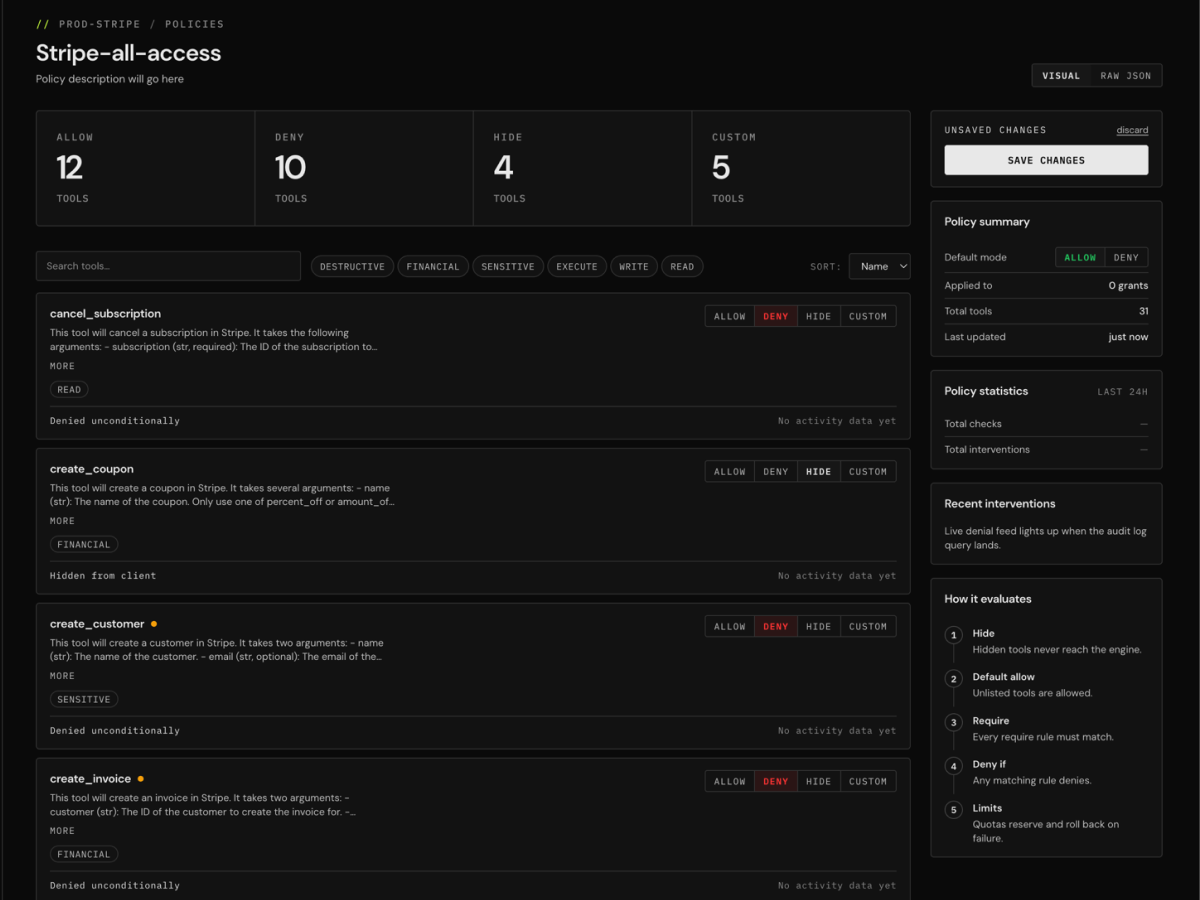
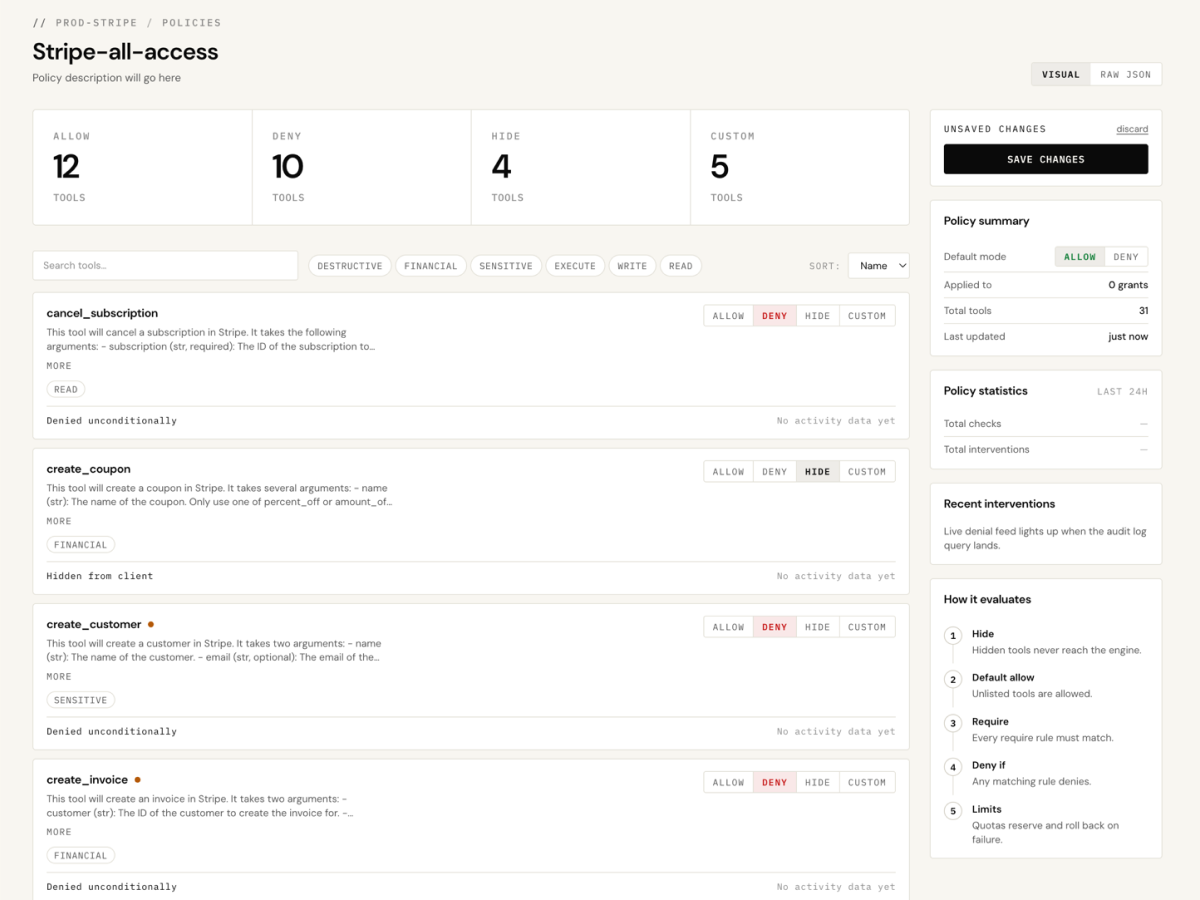
Set defaults, rate limits, denials, approvals, hidden tools, and argument-level conditions.
03
Issue grants
Give each person, agent, CI job, or environment its own scoped token tied to a named policy.
04
Connect client
Paste the PolicyLayer proxy URL into your MCP client config. Agents keep the same tools. PolicyLayer enforces your rules before calls execute.
//ON EVERY CALL
What PolicyLayer enforces, on every call.
Read-only by default
Grant SELECT and leave it there. DROP, DELETE, and TRUNCATE stay denied unless you explicitly allow them.
Per-identity scopes
Each person or agent's token carries only the queries you grant. An analytics agent reads; only a migration agent writes.
Argument-level rules
Inspect the SQL itself: deny statements matching DROP or TRUNCATE, block DELETE without a WHERE clause, allow only SELECT for read grants. Writing policies →
Query caps
Cap queries a minute, so a runaway agent can't hammer your warehouse.
Deterministic, deny by default
Rules run as code, first denial wins. The same call gets the same decision every time.
Bring your database agents under policy. Enforced on every call, live in minutes.
Build policy around the SQL itself (statement type, tables, WHERE clauses) in the visual editor. Allow, deny, rate-limit, or require approval, per tool. Writing policies →
Read-only grants
Allow only statements beginning SELECT.
Block table drops
Deny any query matching DROP or TRUNCATE.
No blind deletes
Deny DELETE without a WHERE clause.
Approval to write
Writes to production tables wait for a human.
Query throttle
No more than 60 queries a minute, per token.
//THE PLATFORM
Not just rules. A platform.
Whatever your agents touch, the same engine, audit, and access model is doing the work underneath every rule you write.
Deterministic engine
Rules run as code, not model judgement: argument-level conditions, quotas, deny-by-default. The same call gets the same decision every time.
Every call is logged with its decision and the rule that fired, attributed to the identity, in an append-only record. Argument values are redacted, never stored.
Policy is evaluated in memory before the call is forwarded, so the overhead is negligible. Allowed calls pass straight through to your database.
Where do my database credentials live?+
Upstream credentials are encrypted at rest and injected by the gateway. Your agents only ever hold a scoped token, never your database credentials.
Do my agents lose any tools?+
No. Agents keep the same tools and schemas. PolicyLayer enforces policy on each call (allow, deny, rate-limit, or require approval), apart from any tools you deliberately hide.
Can I see what my agents actually did?+
Yes. Every call through the gateway is logged with the tool, its arguments, and the allow or deny decision. State-changing dashboard actions are recorded in a separate admin audit log.
Can I revoke one agent without disrupting the others?+
Yes. Each agent or automation connects with its own scoped grant token. Rotate or revoke any grant on its own and the rest keep working.
Let agents query your data without risking the table.
Read-only defaults, argument-level SQL rules, query caps, and a tamper-proof audit log on every database call. Route your existing database MCP servers through the gateway, live in minutes.