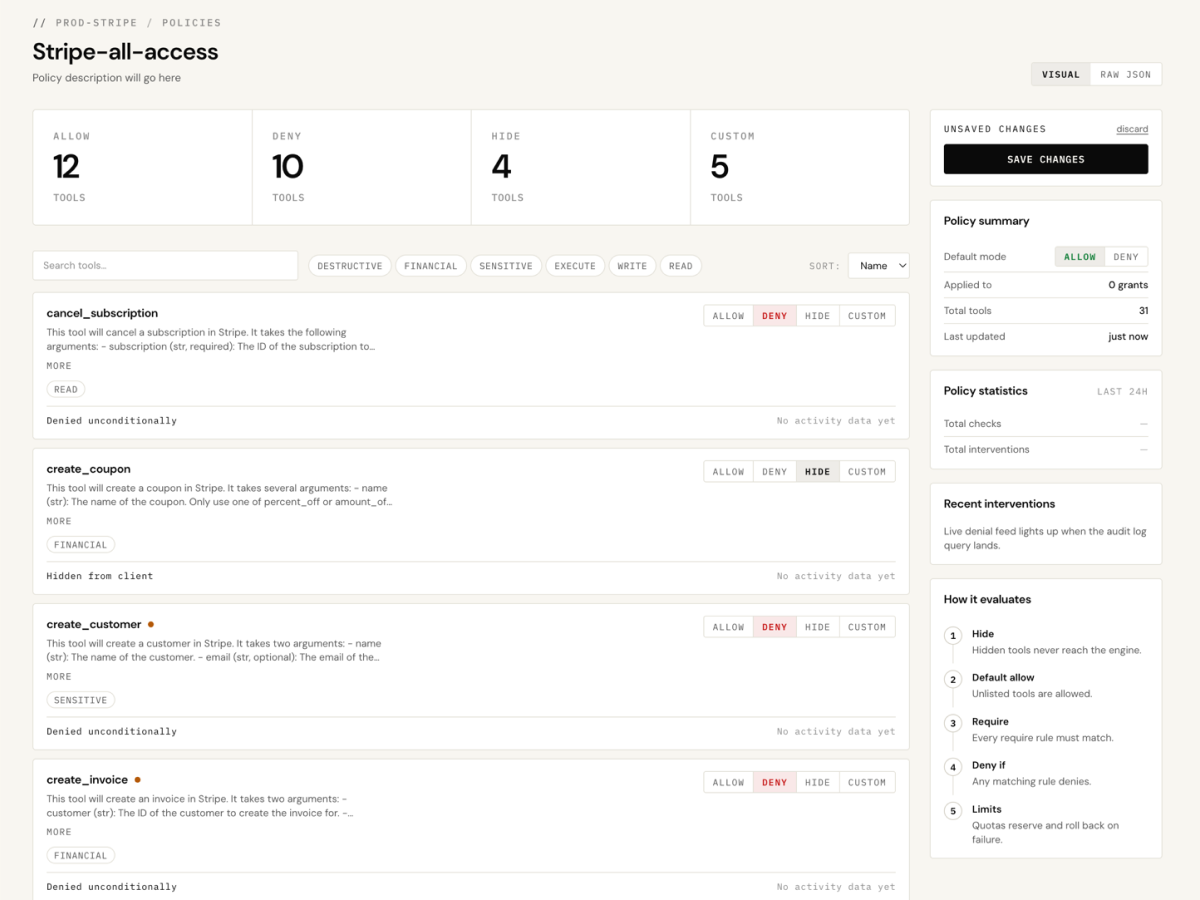
PolicyLayer is the control plane your MCP traffic runs through. Connect your servers once, grant each person a scoped token, and every tool call from every seat is checked against your policy before it runs.
For platform and security teams running AI agents in production.
It rarely starts as a decision. It starts as one engineer's config file.
Each person pastes the same admin API key into a local config. Access is granted by copy and paste, and nothing records who has what.
Keys live in dotfiles and never rotate. When someone leaves, their access does not, and rotating the shared key breaks everyone at once.
Something changes in a connected system and there is no record of which person's agent made which call, or why it was allowed.
The servers a team connects first. PolicyLayer scopes each person's access to them individually.
Drop PolicyLayer into your MCP request path. Your agents keep their tools. You keep control. Core concepts →
Each person connects with their own grant. Upstream keys stay encrypted in the gateway and never land in a local config.
Rules apply across every server and every seat. Change a rule once and it binds the next call. Writing policies →
Revoke one person's grant and their access ends with it. No upstream key needs rotating, and nobody else notices.
Every call is logged with who made it, the tool, the arguments, and the allow or deny decision.
Rules run as code, first denial wins. The same call gets the same decision every time.
Build policy around who is asking (team, role, agent) in the visual editor. Allow, deny, rate-limit, or require approval, per tool and per person. Writing policies →
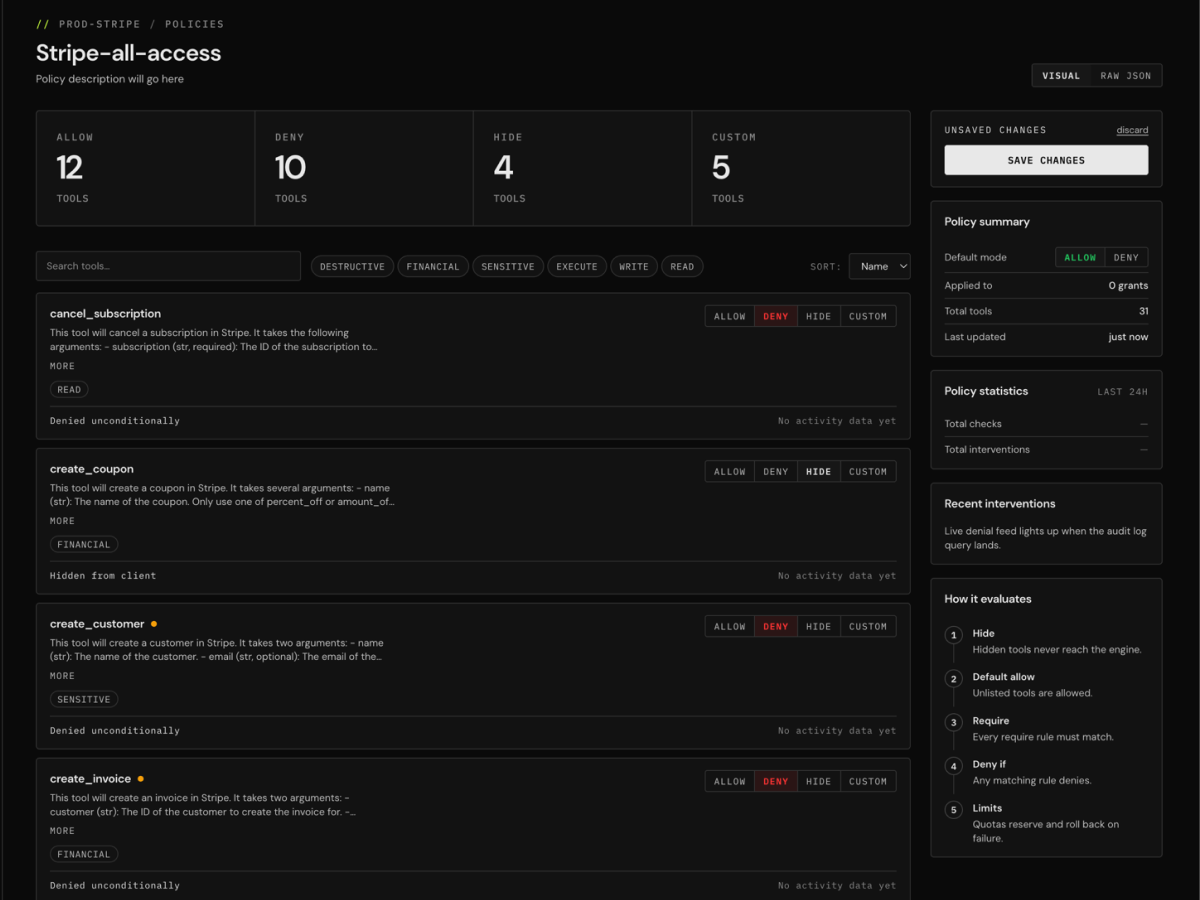
Whatever your agents touch, the same engine, audit, and access model is doing the work underneath every rule you write.
Rules run as code, not model judgement: argument-level conditions, quotas, deny-by-default. The same call gets the same decision every time.
Writing policies →Your security or compliance team writes and attaches policy without ever holding the upstream credentials or grant tokens.
Roles →Every call is logged with its decision and the rule that fired, attributed to the identity, in an append-only record. Argument values are redacted, never stored.
Logs & security →Upstream secrets are encrypted at rest and injected by the gateway. The agent only ever holds a scoped token.
Logs & security →Every person and agent connects with its own scoped grant. Rotate or revoke any one of them instantly, without disrupting the rest.
Core concepts →Hosted gateway. Point your clients at it, register a server, issue a token. Nothing to install.
Quick start →They add the gateway URL and their personal scoped token to Claude Code, Cursor, or any MCP client. No upstream API keys on laptops, and no per-server setup per person.
Revoke their grant and their access ends immediately. Nobody else is disrupted and no upstream key needs rotating.
No. Register the servers you already use with the gateway once. Clients point at PolicyLayer instead of at each server directly.
Policy is evaluated in memory before the call is forwarded, so the overhead is negligible. Allowed calls pass straight through to your servers.
Upstream credentials are encrypted at rest and injected by the gateway. Your agents only ever hold a scoped token, never your upstream API keys.
Per-person scoped tokens, one central policy, instant offboarding, and a tamper-proof audit log on every call. Route your existing MCP servers through the gateway, live in minutes.
Free to start. No card required.